Awakening within the Dream:
Highly Sensitive Women, Persephone, and, “La Vida es Sueño”
Most sensitive women I’ve met have been told their entire lives that they are too sensitive, too much, difficult, miserable, looking for attention, a problem. But this narrative and the extent to which it is reinforced and defended systematically, indicates something very different. That sensitive women are far more dangerous than they are weak. I have observed that many, if not all, sensitive women carry a powerful purpose in healing, awakening, prophecy, sight, and embodiment of what the collective is unwilling or unable to acknowledge. She is the archivist and metabolizer of the grief of the collective.
I tell many of my clients to make a practice of asking, “Who benefits from this version of events?” So, who benefits from the version that sensitive women are weak, liabilities, burdens, difficult, dysfunctional? And who benefits from doubling down on this narrative when these women, through their sensitive embodiment, offer a clear reflection of the pain and dysfunction that exists in the collective? The answer is never, “Me.” It is most often some version of the systems who thrive on dysfunction and cause this pain, and the people who want these systems to stay intact as they are. It’s often the people who most want to avoid growth or who most fear it, those who most want to stay asleep.
A sensitive woman who won’t go along with ‘the way things are,’ is a direct, terrifying threat to the patriarchy. Patriarchy survives through collective emotional suppression, arrested emotional development, and fragmentation from an experience of unconditional love. A sensitive woman is the most likely to either be unable, or unwilling, to ignore the pain she feels. She can’t unfeel what she feels, or unsee what she sees. Her body is an archive of the Earth’s experience, and it speaks to her loudly, sometimes prophetically. Her body feels all it does because it is meant to. She’s sensitive because she was built for a function this world has tried to make her forget.
When she is repeatedly told a version of the story of herself, “You are difficult, too much, a problem,” this is because she is harder to control. They mean, ‘I feel uncomfortable because in your presence I can’t stay sleeping, I can’t continue to numb and avoid what I don’t want to look at. In your presence, I can’t pretend that these systems are dysfunctional, built on suffering. Your sensitivity is inconvenient to my avoidance.’
Have you ever wanted to sleep in on a weekend morning, but your cat/dog, or child, comes to wake you up because they are hungry, or need to go pee, or want to be awake in the sun, with you? And you get annoyed, because it feels blissfully comfortable in your soft bed, in your whimsical dream, where you don’t have to think about reality, where it feels effortless, where you just want to float?
But in this moment, the trade for staying in your blissful dream might be the continued discomfort of the being in front of you, who can’t pretend they don’t have to pee, or that they don’t feel the pain of hunger in their belly, or their desire to bask in the sun, with you? This being who wants you to be awake because awake is when they get to know you, love you, and be loved by you? Now imagine this is your inner child, your more fully actualized Self, the universe nudging you to be in connection with the rawness of this life, the Earth Mother asking you to bask in her wild yet unconditional love?
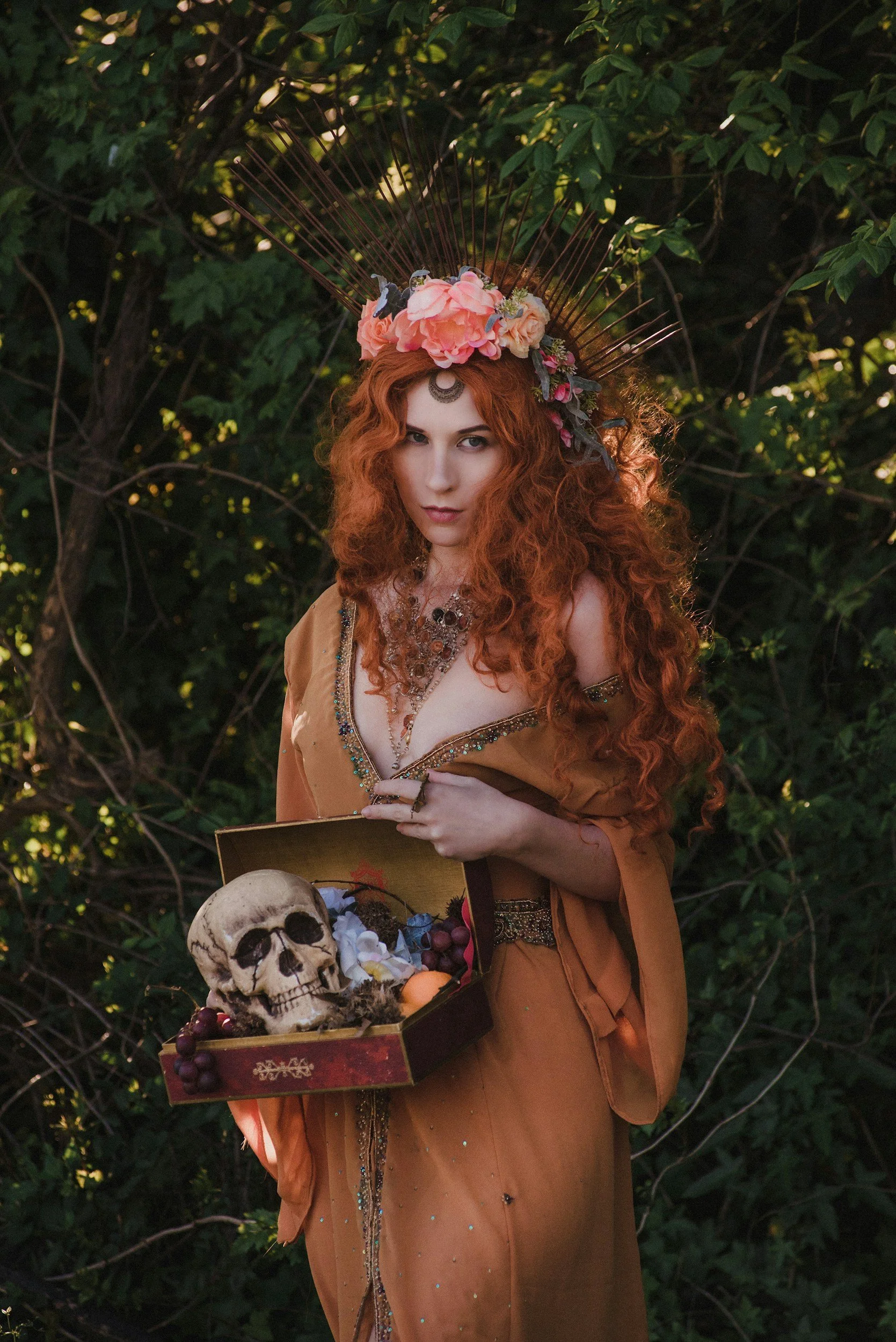
Photo by Noel Nichols via Unsplash
Life is a Dream
A healthy, otherwise asymptomatic person will more often than not experience symptoms when placed in a dysfunctional environment. But it is easier to assign individual pathology to the person experiencing symptoms, than to hold the entire system, the constructed story, accountable to change.
Many highly sensitive women have a powerful purpose in our world; of having one foot in this world and one in the underworld, of ushering the collective towards awakening and coherence. The highly sensitive woman walks through this world with the sense that there is a layer underneath that others aren’t sensing into, but that she is not able to ignore, because she feels it everywhere. So she carries this feeling with solitary grief.
In 1635, the Spanish playwright Calderón de la Barca wrote “La Vida es Sueño,” about a prince named Segismundo who was imprisoned at birth because he was prophesied to be powerful enough to usurp the king’s control. The king, his own father, perceiving this as a threat to his own power, locked him away and told him his nature was dangerous. And Segismundo grew up inside that story, inside that cage, until the moment he woke up enough to ask, “Who told me this, and what did they need from me believing it?” When Segismundo does finally awake, it appears at first through his anger that he will fulfill the prophecy, and he is indeed powerful, but in the end he chooses love and forgiveness.
Calderón wrote “La Vida es Sueño,” during the time of the Spanish Inquisition, right in the middle of this vast project of colonial and religious power consolidating itself, and his question, “What is the nature of the reality we inhabit, who constructed it, what is dream and what is real?” was itself dangerous in that time and place. Because those in power need you to believe the dream is real. They need you to believe the hierarchy is natural, that the earth is an extractive resource and not a mother, that your body is something to be managed and not listened to.
And in Calderon’s story, the moment of waking inside the dream is when the story starts to shift for Segismundo. He doesn’t escape the dream by finding the exit. He wakes up within the dream and starts to notice the constructed theatre around him, and actively chooses differently. It is because he experienced the blurring of the lines between reality and illusion that he is able to see through the veil and choose differently.
The highly sensitive woman walks through this world with the sense that there is a layer underneath that others aren’t sensing into, but that she can’t ignore. And she feels it everywhere. The grief she carries as a result of the isolation and abandonment she experiences, often from part of her initiation into occupying space within both the waking and the dream world, this world and the underworld. Her role is important and she is learning to expand into the capacity to exist in both worlds. And in order to do that, her conditioned identity must die. These initiations may feel a bit like ego death, or depression, or breakdown, or instability, or darkness, as part of this deconstruction, in order to reconstruct from the memory of who she was before the world told her who to be.
And she may traverse some of these initiations alone, the circles and lineages that once carried women through these thresholds having been systematically scattered and disrupted by patriarchy.
Persephone
In the Greek story of Persephone, she begins as a young, innocent girl picking flowers in a field. She lives under the care of her mother, Demeter, in the green, sunlit waking world. In the field, the earth opens up and swallows her into the underworld. While there, she eats 6 pomegranate seeds, which bind her to to the underworld. She can’t go back to the existence she had before.
In this telling of the story, she doesn’t originally choose this initiation. In fact, in many versions of the story, Persephone is a passive victim. She is kidnapped against her will, bound to this world away from her mother, and her mother’s grief at her loss causes a devastating winter. But we also know that the voices carried through recorded history most frequently are of course… men. What happens if Persephone tells the story herself, with her own experience at the center?
If we consider that the earth opening up and taking Persephone in is an initiation, our understanding of Persephone can expand. Perhaps she was following an intuitive pull, a calling, and went searching for a crack in the Earth. And the pomegranate seeds are a fascinating detail because eating is such a primal, embodied act, and it is her body that seals the initiation and makes the crossing permanent. In this story, the pomegranate is tied to the underworld and to death, but in the same Greek pantheon pomegranates are also symbolic of Aphrodite, of femininity, fertility, and beauty. So, what if eating the pomegranate seeds was actually Persephone’s awakening to her own power, her own pleasure, her own multitudes, beyond the innocent, springlike maiden role she filled before?
Women with appetites (for food, pleasure, adventure, for knowing herself, for love, for life) are often portrayed as dangerous, sinful, difficult, crude, messy. But a woman with an appetite and a curiosity can live in full contact with her senses, with the world, and with herself. She cannot be boxed in. Perhaps Persephone wasn’t the naïve, innocent maiden the storytellers portray her as; perhaps she had an appetite, a desire to taste the pomegranate, to dive into the shadow, to challenge the limitations of her existing reality. Perhaps she couldn’t ignore the sensory experience of her own body, asking to taste the seeds, asking to look beneath the veil.
For many sensitive women, their transformation and awakening to their own power and sovereignty will also elicit grief in their mothers or their family members. Grief that she is no longer the same person she was to them anymore, or the version they wanted from her (compliant, obedient, ‘good’). She is no longer existing for their purpose and comfort, but for her own. And she may now embody qualities that seem more edgy, fierce, boundaried, angry, and raw than before she awoke. Her awakening threatens their sleep. The woman may grieve her own awakening to the knowing of her Self beyond the utility she serves for others, that she may become estranged from those who don’t desire to know her beyond her usefulness.
Perhaps what feels like devastating loss and death to Demeter, and perhaps to Persephone in her own way, is actually a rebirth. An awakening from the trance. She descends to the underworld, the shadow, in her own heroine’s journey, in order to actualize her embodied sovereignty and freedom. Perhaps Persephone’s purpose and actualized Self existed in a world her mother feared, or was taught to fear. Perhaps the underworld is not what we are led to believe, and grief is not a sign of something gone wrong.
The sensitive woman’s descent is her own and it’s a response to real conditions. Her grief is personal and it’s ecological, collective. Her exhaustion is her own body’s and it’s the body’s refusal to participate in collective disillusionment and systematic dissociation.
ways to work with me:
Online somatic and soul-centered counseling, yoga,and Brainspotting for women located in Bend, Oregon and the state of Oregon. Click here to schedule a free consultation.
Read more about sacred becoming therapy hereand my approach to working with cycle breaking women here.
Enter your email at the bottom of this page to stay up to date on offerings!