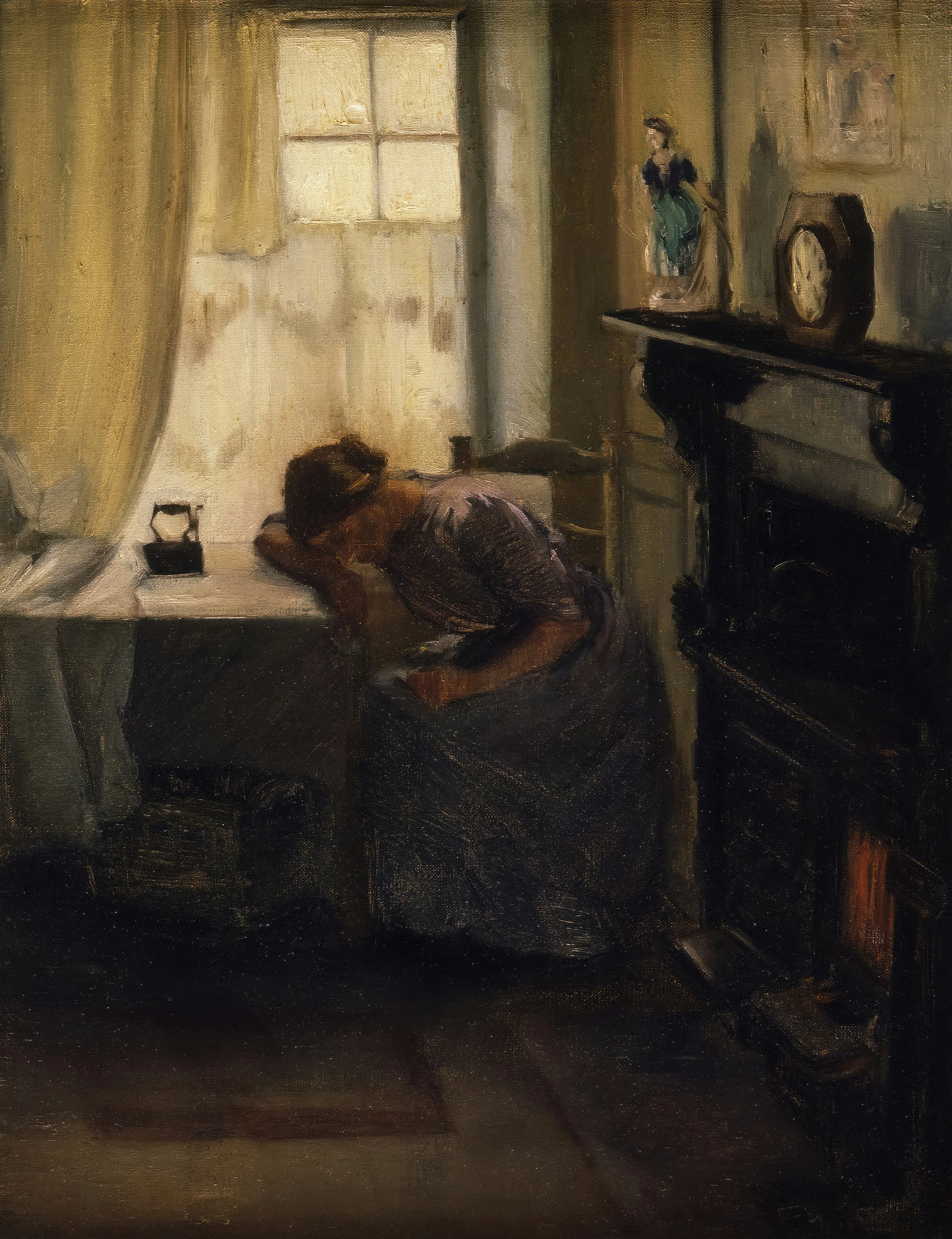
Museum of New Zealand Te Papa Tongarewa
“Tired,” by Mina Arndt, Circa 1908.
Expansion Work and Supporting Women with Burnout
I remember getting a lot of messages for a period of time on wellness Instagram that said, ‘if you’re burned out, you’re doing too much,’ ‘if you’re burned out, you need to rest more,’ etc.
But in my experience personally, and with many of my clients, rest is important, but is often far from the full story.
Every time I have been expanding into a fuller version of my life that I have been working towards, that I have been envisioning, wanting, dreaming, that is more authentically aligned, that I am genuinely ready for, my nervous system capacity starts to shrink and tense around the expansion, and my functioning takes a dip.
Aside from the obvious reasons which is that we are asking more of our brains, bodies, and hearts when we expand into new territory, my experience is that it goes beyond that, especially when one is living with developmental trauma, attachment wounds, etc., which is why the advice to rest more can be more of a temporary band-aid than a long term solution.
I think there are a few different ways that burnout can manifest for women beyond overextending themselves, or the narrative of ‘doing too much.’
1. Your nervous system learned a lack of safety around abundance, expansion, happiness, and lightness somewhere along the way. “Waiting for the other shoe to drop” applies here, and so does having experiences in childhood such as caregivers that said they loved you but then were abusive or neglectful, or being a parentified child who was praised for being ‘so mature for her age, so easy.’ The nervous system learning that abundance isn’t safe can develop in many different ways for each person who experiences this.
2. You have learned through experiences of your own that the world or the environment around you doesn’t respond well when you are your authentic self, when you are honest about your needs, when you have feelings, when you step outside of your expected role, or when you take up space and act like a full human being. You have perhaps also, through observation, seen that many, many other women in your life or throughout history have not been treated well when they live as their authentic selves. This has taught you that you are, ‘too much,’ ‘asking for too much,’ ‘not enough,’ or ‘not able/capable/an imposter.’
3. You are undiagnosed, suspect you are, or late diagnosed ADHD or Autistic, or you are a highly sensitive person (HSP). This means that you are making thousands of often invisible accommodations daily in order to function at the level you need to function, for yourself, at work, and for others, which uses up a large portion of the available resources in your bucket. At the end of the day, you have left resources left over. If you add in any life changes, children, other disabilities, perimenopause, etc., this becomes harder as systems of accommodation that normally help you function become less doable or not feasible, or the demands of your life supersede the systems of accommodation that have helped you, using up all the resources in your bucket.
4. Loneliness. Staying in environments or relationships that are not reciprocal, in which you are expected to over function to keep things together and working smoothly, or in which you play the role of teacher, therapist, rehabilitation center, parent, caregiver, for everyone else, and are expected to settle for crumbs when it comes to your own needs. This one sort of falls into the ‘doing too much,’ category, but over functioning in relationships is a lot more complex than, ‘doing too much.’ You might have learned to tolerate relationships like this because it’s what is most familiar to you, because you’ve learned or you’ve been told that if you take up space, or if women take up space, they face abandonment, loneliness, and abuse, which is true. But loneliness that comes with choosing yourself is far different than loneliness that comes from being around people who don’t see you and don’t want to, or who value you only for what you offer to them. Being valued and being loved are not the same thing.
a. There’s another kind of loneliness that I think comes from being a person who hasn’t filled all of the conventionally expected milestones that mark their status or value societally. For women, this would be marriage, children, or marriage and children. Single women, child free women, entrepreneurial women, career driven women, women who become mothers in different ways (I see you, Dolly Parton), rebellious women, outspoken women, honestly I could keep going with this list for pages and pages, it’s endless really so I’ll stop here. See America Ferrera’s monologue in the Barbie movie if you please. But these women become self sufficient for a number of reasons, but often are abandoned socially in many ways and carry a lot alone. There can be a freedom, but also a lonely weight, to living outside of the script that was handed to you by the hegemonic powers that be, or sometimes, your own mother.
5. You are asking more of yourself, of your life, than what you were taught was safe to ask for. There can be ancestral trauma and intergenerational family burdens here, societal or existential influence, or just an unfamiliarity in stretching into a way of being you’ve never embodied before. This can ask a lot of your nervous system, and while rest is helpful for sustainable growth, there’s often more to it that involves growth.
a. In the U.S., Gen X and Millennial women are the first generations of women to have grown up in a world where women are allowed to open a credit card or take out a loan without a male cosigner. That didn’t become a protected right until 1974. Title IX wasn’t signed in to law until 1972. My mother was already 18 by this time and the activities she was allowed to participate in during high school were cheerleading and home economics. This is not to mention any other form of ancestral trauma that could exist in your lineage. Being able to dream big in the way many of us have grown up doing is unprecedented. Our bodies and nervous systems carry memories of generations before us, both beauty and challenge.
6. You’ve been navigating multiple intersections of systemic oppression and systems that were built to profit off of people, not to help them heal or thrive (despite promises that sell a different story). Perhaps you’ve been waking up to even more ways this has been happening (for a very, very long time) that you didn’t know about before. Maybe you’re the only one in your social circle who seems to care about what you’re seeing. You feel tired from constant headlines about new atrocities every day, you have deep existential rage and grief, and perhaps you also feel helpless or powerless in understanding what to do, how to respond, how to make sense of how this changes your idea of who you were or what the world was, and yet you’re expected to keep showing up to work or getting your kids to school per usual. It’s a lot.
7. Last one for today: Avoidance. You’ve been spending years avoiding living larger or asking for more than what you’ve allowed yourself to live or dream of, but this avoidance is an avoidance of yourself, which is e x h a u s t i n g. Avoidance takes a big toll on the nervous system, and often uses far more of our resources than just doing the thing. Avoidance creates its own pain in a way; sometimes I tell my clients, “it will be painful either way. But you are choosing what kind of pain it will be.” The pain of avoidance often cuts keeper, and festers rather than heals. Just because it’s the more familiar pain doesn’t mean it doesn’t hurt more. It’s important to note here though, that there’s usually a reason you’ve avoiding something and that is relevant to where I’m going with all of this. However, with the world as it is, I think many people are starting to become aware of just how fragile life is, that there are not guarantees, and maybe it is worth the risks to at least try because if not now, when?
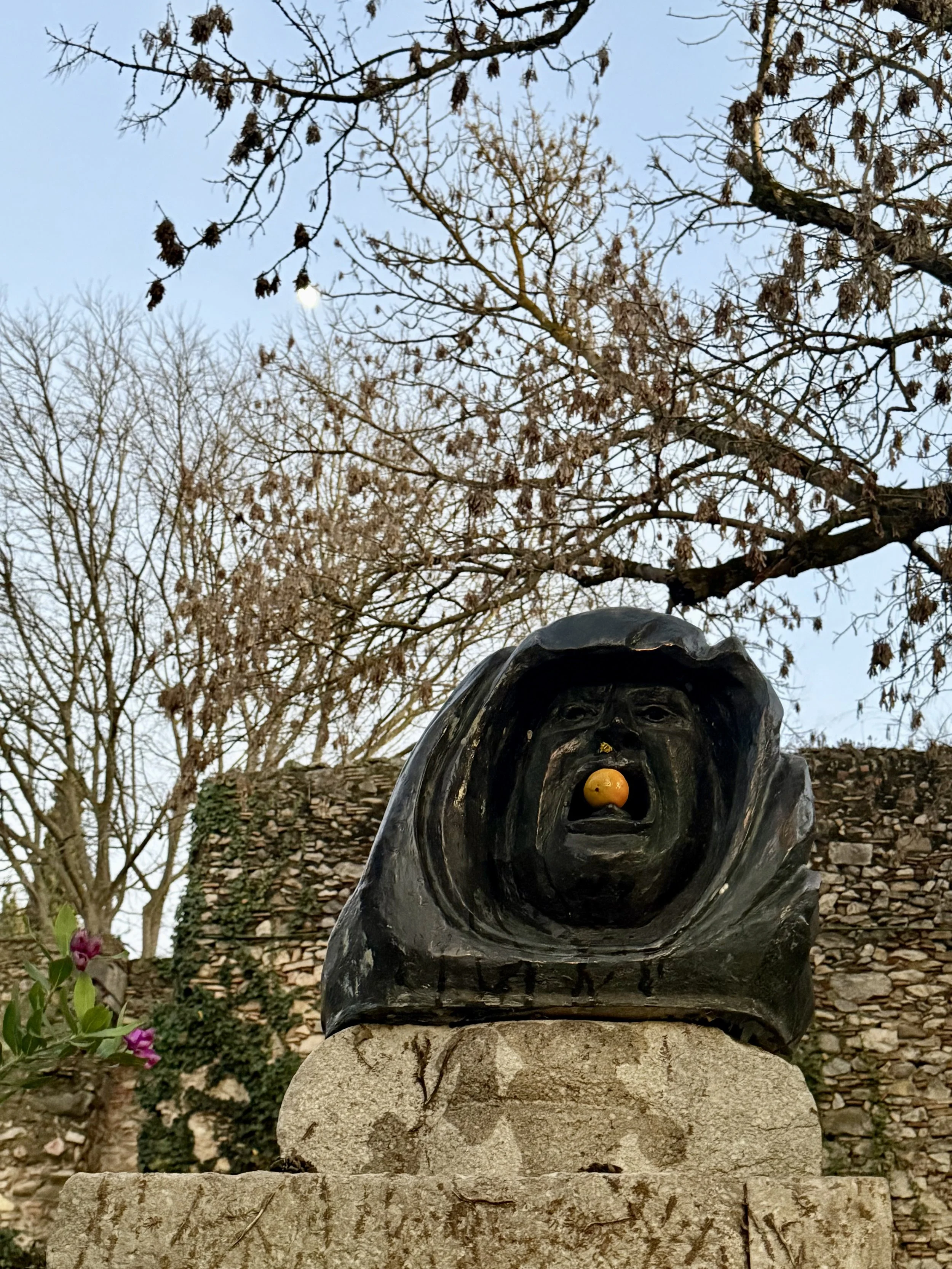
“El Crit de la Bruixa,” Girona, Spain (With an added embellishment from an unknown tourist)
So what more can we do to help with burnout if rest doesn’t cut it? I call this area expansion work. Where we are doing work that specifically expands your nervous system capacity to hold not only more of everything, but more abundance, joy, self trust, lightness, play, and pleasure. Expansion work also helps deepen your relationship to yourself, which expands your capacity to stay the course when those who will be angry with you, who will abandon you, say unkind things, disbelieve you, try to prevent you from being you, inevitably do their thing. It’s sort of like igniting the light at the end of the tunnel so that you don’t forget it’s there. Creating safety for joy, play, and pleasure also means creating space for things that will also fill your cup, not only take from it. Expanding will still involve discomfort and hard work, but we can grow your capacity to hold all of it and to remember the light that is waiting for you, your WHY.
We spend time mapping what you are dreaming of, what your inner child longs for, how you want to embody your presence in the world for your children, yourself, for all of us. And then we help your body learn to stretch into that dream without collapsing or freezing.
I have found that expansion work is most effective with an integrative approach that includes somatic work, relational/attachment focused approaches, narrative work, and depth. This will look differently for each person, but if you are in a chapter of burnout in your life, consider thinking beyond processing old trauma or wounds, and into expanding capacity to hold the life you’re living or dreaming into. Find people who will enthusiastically support your dreams and desires, and your inner child whimsical urges, even if they exist outside of your current circle.
Hi! I’m Erica Barton, licensed psychotherapist, intuitive, yoga therapist, teacher, and guide, extraordinaire. I love working with women to heal past wounds for good and deepen their relationships with their true selves, while expanding into the lives they truly long to live. One of my favorite things is to lift other women up so the world can experience their wonderful gifts.
I like to live by example, but imperfectly. I won’t be sitting on any pedestals any time soon, thank you very much. There’s too much goodness in the messy bits, much like the crusty corner slice of brownie or the burnt cheese at the edges of a lasagna pan.
I’m currently accepting new clients for 1:1 work for therapy (Oregon only) and coaching/yoga therapy, online only. See some more options below!
WAYS TO WORK WITH ME:
Online somatic and soul-centered counseling, yoga, and Brainspotting for women located in Bend, Oregon and the state of Oregon. Click here to schedule a free consultation.
Read more about sacred becoming therapy here and my approach to working with cycle breaking women here.
Enter your email at the bottom of this page to stay up to date on offerings!